WebP to PDF conversion turns WebP images into PDF pages in your browser. Add one image or a group of images, place them in the sequence you need, and choose page settings before downloading. It is a practical way to package web images, screenshots, photos, or scans as a PDF for sharing or printing.
What you can do with WebP to PDF
Set WebP to PDF page order before converting
Each WebP you select becomes a PDF page. Drag the image cards until they appear in the sequence you want, then convert. Pages follow the cards from left to right exactly as they are displayed, making it easy to prepare a document from a mixed group of images.
Make one PDF or a separate PDF for each image
Use the Output setting to combine all selected images into one PDF. Turn that setting off when every image should become its own PDF instead. If you select only one image, the result is naturally a single PDF, regardless of the output choice.
Choose Letter, A4, or a page sized to the image
Choose Letter for common US printing at 21.6 × 27.9 cm, or A4 for office-standard documents at 21 × 29.7 cm. Select Fit to image when you want the page to match the image dimensions, leaving no empty edges around it.
Use automatic portrait and landscape pages
Automatic orientation gives landscape WebPs landscape pages and portrait WebPs portrait pages, which helps when your selection includes both shapes. You can also force every page to Portrait or Landscape. Orientation is not used with Fit to image because the page already takes the image size.
Leave the margin your pages need
Choose None when the image should run to the page edge. Small leaves a thin white frame that can help prevent printer edge clipping. Large creates more surrounding space, which can be useful for binding a printed document or adding handwritten notes later.
Know how animated and transparent WebPs appear
Animated WebP files use their first frame when converted. If a WebP has transparent regions, those areas appear on white paper in the resulting PDF. These format details are handled consistently, so you can choose images with a clear expectation of how each page will look.
How to webp to PDF online
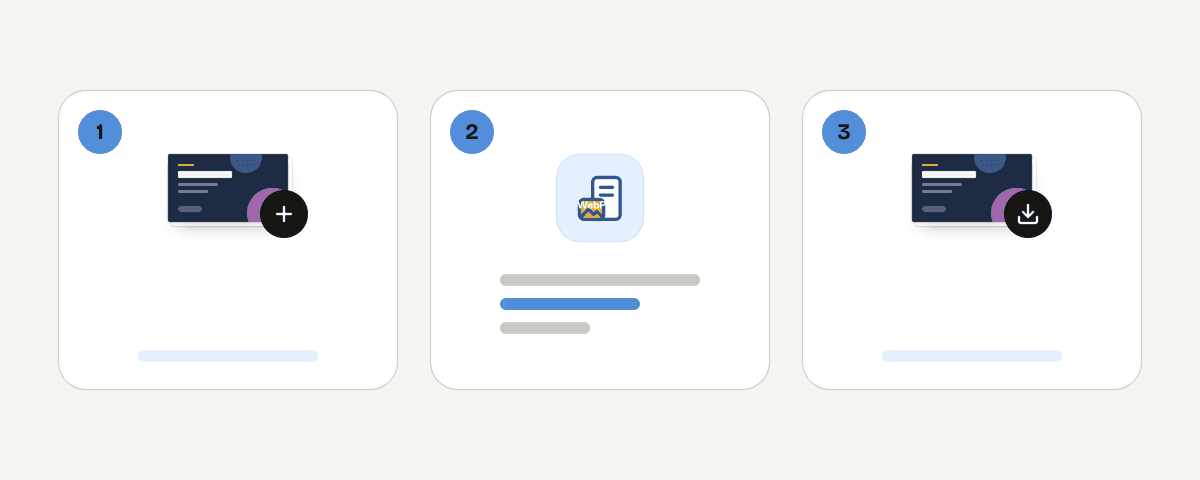
Add the WebP images you want to convert
Choose “Select WebP files” and select one or more WebP images from your device. You can use images saved from the web, plus WebP photos, screenshots, and scans. Each selected image appears as a card ready to become a PDF page.
Drag image cards into the intended page sequence
Move the cards until their left-to-right arrangement matches the order you want readers to see. Check the sequence before starting the conversion, especially when building a multi-page document from screenshots or a collection of related web images.
Pick page size, orientation, and margins
Choose Letter, A4, or Fit to image, then select Automatic, Portrait, or Landscape orientation when using a fixed page size. Set None, Small, or Large margins based on whether you want edge-to-edge pages, a print-safe frame, or room for notes.
Choose combined output or individual PDFs
Keep the Output setting enabled to turn all selected WebPs into one ordered document. Switch it off if you need an individual PDF for every image. This choice is useful when you are preparing files for different recipients or separate records.
Convert and download the finished PDF
Start the conversion after reviewing the cards and settings. Download the resulting document when it is ready. For a group converted as separate files, download the individual PDFs created from each selected image rather than a single combined document.
Your WebP images stay on your device
PDF Toucan runs this conversion locally in a browser web worker, so your WebP files are never uploaded from your device. The browser does the work of opening the images, arranging them into pages, and producing the PDF. You do not need an account to use this browser tool, and the downloaded PDF has no watermark. It is free to use, with ads helping fund the site. There are no daily limits for this browser tool, so you can return whenever you need to convert another set of WebP images. Local processing also means you keep control of the files in the browser session on your device.
Runs in your browser: the file never leaves your device.
WebP to PDF – frequently asked questions
How do I convert WebP to PDF?
Select your WebP images, drag their cards into page order, choose page settings, and start the conversion. Download one combined PDF or separate PDFs, depending on the Output setting you choose before converting.
Can I convert several WebP files into one PDF?
Yes. Keep “Combine all images into one PDF” enabled after adding your files. Every selected WebP becomes a page, and the cards’ left-to-right order determines the order of pages in the finished document.
What page size should I use for a WebP image to PDF?
Letter is a useful choice for US printing, while A4 suits office-standard documents. Choose Fit to image when you want the PDF page to match the image dimensions and avoid empty edges around the WebP.
Will animated WebP files convert to PDF?
Yes, but the PDF uses the first frame of each animated WebP file. A PDF page is static, so later animation frames are not included in the converted result.
Are transparent parts of a WebP preserved in the PDF?
Transparent areas are placed on white paper in the PDF. This gives each converted image a white background where the original WebP had transparent regions, rather than retaining transparency on the page.
Do I need to install a WebP to PDF converter?
No. You can convert WebP to PDF online in your browser without installing converter software or creating an account. The conversion runs locally in the browser web worker, and the files remain on your device.
Can I change the order of WebP images before converting?
Yes. Drag the image cards before conversion to rearrange them. The PDF pages follow the left-to-right order shown on screen, so you can set the document sequence before creating the final file.
Once your images are pages, you can use merge to combine PDFs with other PDF documents. If the finished file needs to be smaller for sharing, try compress afterward. These optional PDF Toucan tools work on PDFs after your WebP conversion is complete.
Last updated September 24, 2026